How to Rank in AI Search Results: What Actually Moves the Needle
Ranking in AI search results is less about backlinks and keywords and more about entity clarity, third-party mentions, reviews, and structured content. Here are the real factors and a numbered action plan.

To rank in AI search results - meaning to get named and recommended in AI-generated answers - focus on the factors AI engines actually weight: a clear, consistent brand entity; third-party brand mentions across the web; strong reviews; structured, expert-attributed content; and content freshness. These differ from Google's classic ranking factors, where backlinks and on-page keywords dominated. In AI search, brand mentions correlate roughly 3x more strongly than backlinks with visibility.
What "Ranking" Means in AI Search
In classic search, ranking means your page's position in a list of ten links. In AI search, there is no list to climb. Instead, an engine like ChatGPT, Perplexity, or Google AI Overviews synthesizes an answer and names a handful of brands as recommendations. "Ranking" here means being one of the brands the model names - ideally early, and described favorably.
This reframing matters because the tactics that won the ten blue links don't fully carry over. You are no longer optimizing a single URL for a keyword. You are shaping how a model understands and trusts your entire brand, so that when a relevant question comes up, you are the safe, obvious answer.
As MentionLayer founder Joel House tells it, "People ask me how to 'rank number one' in ChatGPT, and I have to reset the mental model. There is no number one. There's named or not named. The goal is to be the brand the model reaches for by default when someone asks about your category - and you earn that by being genuinely well-represented everywhere the model looks, not by gaming a single page."
The practical implication: AI ranking is won across your whole footprint - your site, your third-party mentions, your reviews, your entity data - not on one optimized landing page.
Old Google Factors vs New AI Factors
The ranking factors shifted meaningfully between the Google era and the AI era. Understanding the contrast tells you where to spend your effort.
| Factor | Weight in classic Google | Weight in AI search |
|---|---|---|
| Backlinks | Very high | Moderate |
| Brand mentions (unlinked) | Low | Very high |
| On-page keywords | High | Moderate |
| Entity clarity / consistency | Moderate | Very high |
| Reviews | Moderate (local) | High |
| Structured, attributed content | Moderate | High |
| Content freshness | Moderate | High |
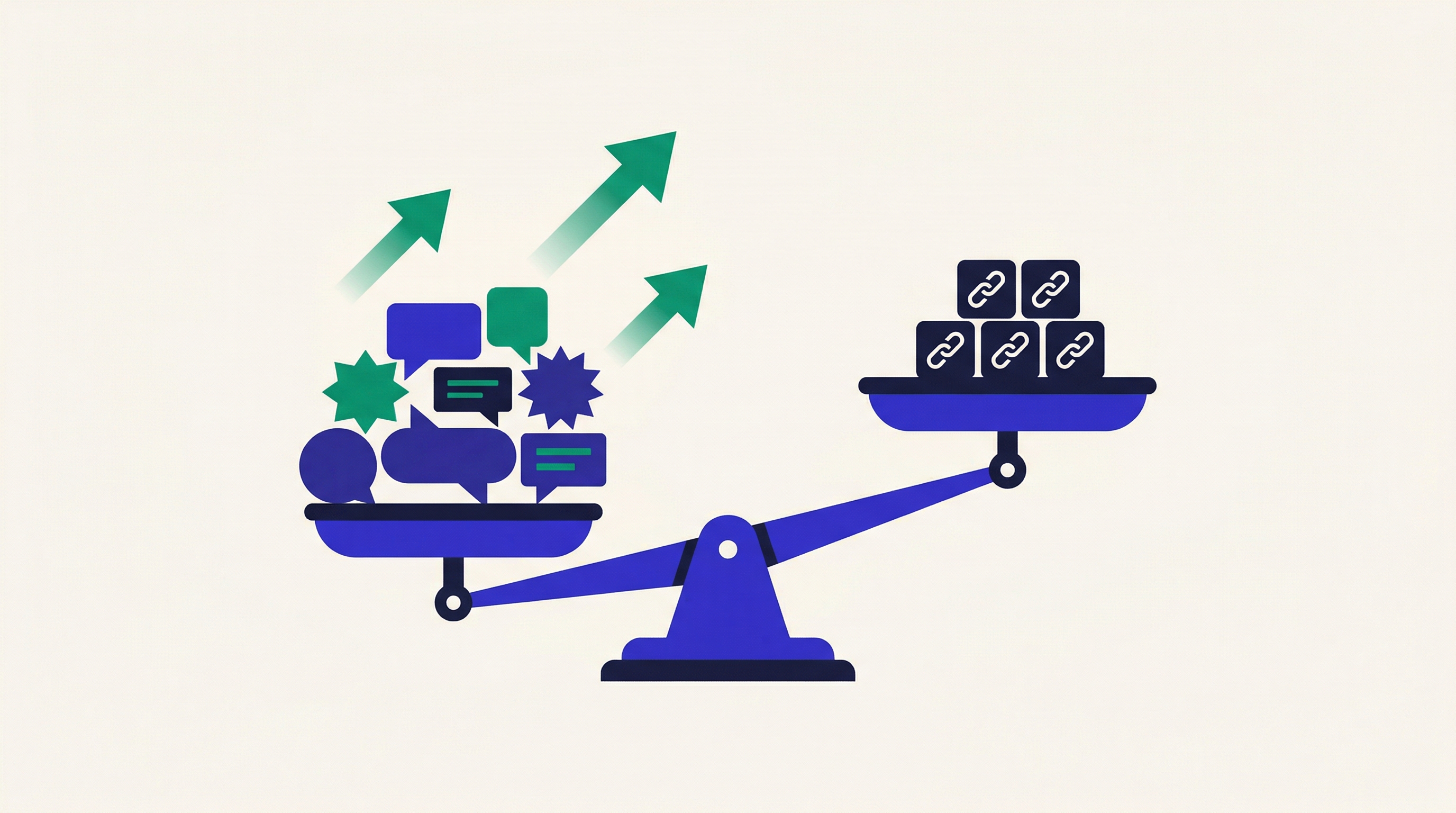
The headline shift is from links to mentions. In classic SEO, a backlink was the dominant vote of confidence. In AI search, simply being named across the web - even without a link - is a stronger signal. A 2026 study from MentionLayer found brand mentions correlate roughly 3x more strongly than backlinks with AI visibility. The full breakdown of brand mentions versus backlinks explains why.
The second shift is toward entity clarity. Google could rank a keyword-matched page even if it wasn't sure what your company was. AI engines are more cautious - they won't confidently recommend a brand they can't cleanly identify. Consistent entity data becomes a gating factor, not a nice-to-have.
The third shift is toward reviews and freshness. Models lean on recent, credible third-party signal to decide who is a safe recommendation right now, not who was relevant three years ago.
The Five Factors That Actually Move AI Rankings
Cutting through the noise, five factors do the heavy lifting. Get these right and you will be named far more often.
1. Entity clarity. The model must know exactly what your brand is - your category, what you offer, who you serve. Make your homepage, structured data, and third-party profiles describe you identically. Every contradiction erodes the model's confidence and pushes you out of the answer. This is the foundation everything else sits on. See how AI models choose.
2. Third-party mentions. Being named across the sources models retrieve from - reviews, roundups, community threads, press - is the strongest underused lever. Because mentions outweigh backlinks, a single well-placed brand mention in a high-authority thread can do more than a batch of links.
3. Reviews. Volume, recency, and rating across trusted platforms feed directly into whether the model sees you as a credible pick. A brand with fresh, positive reviews is a safe recommendation; a brand with none is a risk the model avoids naming.
4. Structured, expert-attributed content. Content with clear sections and named authors gets cited about 65% more often, per the same MentionLayer study. Lead with direct answers, use clean headings, and attribute your content to real experts so models can quote you with confidence.
5. Freshness. AI engines favor current information. Recently updated content and recent mentions signal that your brand is active and relevant now, which matters more in AI search than it did in classic ranking.
A Numbered Action Plan to Rank in AI Search
Here is the sequence to work through. It moves from measurement to foundation to signal-building, mirroring the way AI visibility actually compounds.
- Baseline where you stand. Ask your customers' real questions across ChatGPT, Perplexity, Gemini, and Google AI Overviews. Record whether you appear, which competitor appears instead, and which sources get cited.
- Unify your entity. Audit your homepage, schema markup, and every third-party profile. Make the description, category, and core details match exactly. Fix every contradiction first - this is the gate.
- Build third-party mentions. Target the sources models retrieve from. Get named in industry roundups, credible review platforms, and high-authority community threads where your category is discussed.
- Grow reviews with recency. Systematically earn reviews on the platforms that matter to your category, and keep them flowing so the signal stays fresh.
- Restructure your key content. Rewrite priority pages to lead with a direct answer, use clean sections, and attribute to named experts. Make it trivially easy for a model to lift and quote.
- Refresh and maintain. Update important pages and keep earning new mentions so your freshness signal stays strong.
- Re-measure monthly and double down. Track your share of the answer over time and pour effort into whatever moves it.
For a fully sequenced version with weekly milestones, the 90-day AI visibility playbook lays out exactly what to do and when. And the complete GEO guide covers the underlying discipline in depth.
Common Mistakes That Keep Brands Out of AI Answers
Even well-resourced brands stall on AI ranking by repeating a few avoidable errors. Watch for these.
- Treating it as pure SEO. Pouring budget into backlinks and keyword pages while ignoring entity clarity and third-party mentions leaves the highest-leverage factors untouched. Ranking on Google and ranking in AI answers are related but not the same job.
- Inconsistent entity data. A brand described three different ways across its site, LinkedIn, and directories confuses the model into leaving it out. This single issue quietly caps visibility for a huge share of brands.
- Thin or stale reviews. No reviews, or reviews that dried up two years ago, signal a brand the model can't confidently vouch for.
- Unstructured content. Walls of text with no clear answer, no sections, and no named author are hard to extract, so they rarely get cited.
- Never measuring. Without a share-of-model baseline, you can't tell what's working. Guessing is the most expensive mistake of all.
The most common failure pattern is a brand that is technically excellent at SEO and completely absent from AI. It did everything the old playbook said, and none of it addressed entity clarity or third-party mentions. The fix isn't more of the same - it's the new factors that got skipped, and auditing against the five factors above usually shows which one.
The context for why this happens is stark: the MentionLayer AI Visibility Index found 65.9% of businesses are effectively invisible in AI search. Most brands simply haven't done the specific work AI ranking requires. A free AI visibility audit shows exactly which of these factors is holding your brand back and where the fastest ranking gains are.
How to Tell If Your AI Ranking Is Improving
Because AI search has no rank tracker in the classic sense, teams often can't tell whether their effort is working. You need a measurement habit built for AI answers, not blue links.
Start with a fixed prompt set. Write down 20 to 40 real buying-intent questions your customers ask - "best X for Y," "X alternatives," "who should I use for Z" - and freeze that list. Consistency is what makes the trend readable; if you change the questions every month, you can't compare.
Run that set across the engines your buyers use on a regular cadence, monthly at minimum. For each run, record three things: whether you were named (presence), how early you appeared in the answer (prominence), and whether a competitor was named instead. Roll it into a single number - your share of model - so you can watch it move.
Watch for these as signals of real progress:
- Presence rising - you're named in a growing share of answers.
- Prominence improving - you move from an afterthought at the end to one of the first brands mentioned.
- Competitor gap narrowing - the brands that used to crowd you out appear less often relative to you.
- Citations appearing - engines begin sourcing your own content, not just naming you.
The teams that win at AI ranking treat it like a scoreboard, not a vibe. They know their share of model this month versus last, which engine is lagging, and which fix moved it. That discipline is the difference between steady gains and six months of guessing. This tracking is exactly what MentionLayer runs automatically across five engines, so the trend and the competitor comparison are visible without manual spreadsheets.
Frequently Asked Questions
Can you actually rank number one in AI search?
Not in the way you rank on Google. AI engines synthesize answers and name a handful of brands rather than producing a numbered list. The real goal is to be named - ideally early and favorably - when a relevant question comes up. Being the model's default pick for your category is the AI-search equivalent of ranking first.
Do backlinks help you rank in AI search?
Backlinks still help, but less than they did in classic Google. In AI search, unlinked brand mentions across the web are a stronger signal - a 2026 MentionLayer study found brand mentions correlate roughly 3x more strongly than backlinks with AI visibility. Invest in getting named widely, not just in earning links.
How long does it take to rank in AI search results?
It varies by starting position, but meaningful movement typically takes weeks to a few months as you fix entity data, build mentions, and models pick up the new signals. A structured 90-day plan is a realistic horizon for a brand starting from low visibility, with entity fixes often showing the fastest returns.
What is the single most important factor for AI ranking?
Entity clarity is the foundation - if a model can't confidently identify what your brand is, it won't recommend you regardless of your other signals. Once your entity is clean, third-party brand mentions become the highest-leverage factor because they outweigh backlinks in driving AI visibility.
Check Your AI Visibility Score
Run a free 5-pillar audit and see where your brand stands across Citations, AI Presence, Entities, Reviews, and Press.
Run Free Audit →Related Articles

How AI Models Decide Which Brands to Recommend (And Why Yours Might Not Make the List)

From Invisible to Recommended: A 90-Day AI Visibility Campaign Playbook
Brand Mentions vs Backlinks: Why Mentions Matter 3x More for AI
What Is AI Visibility? The Complete 2026 Primer

What Is Generative Engine Optimization (GEO)? The Complete Guide for 2026
The GEO Briefing
What the AI engines changed this week
One email. Fresh data from our 1,004-business visibility index, what moved, and the single highest-leverage thing to do about it.