Topical Authority vs Domain Authority: Which Matters More for AI?
Domain authority measures backlink-driven ranking power. Topical authority measures content-driven expertise. For AI visibility, they serve different purposes — this comparison explains which to prioritize and when.

For Google rankings, both domain authority and topical authority matter. For AI citations, topical authority matters significantly more — brand mentions correlate 3x more than backlinks with AI visibility, and content depth drives citation selection more than domain-level link equity.
Two Authority Metrics, Two Different Signals
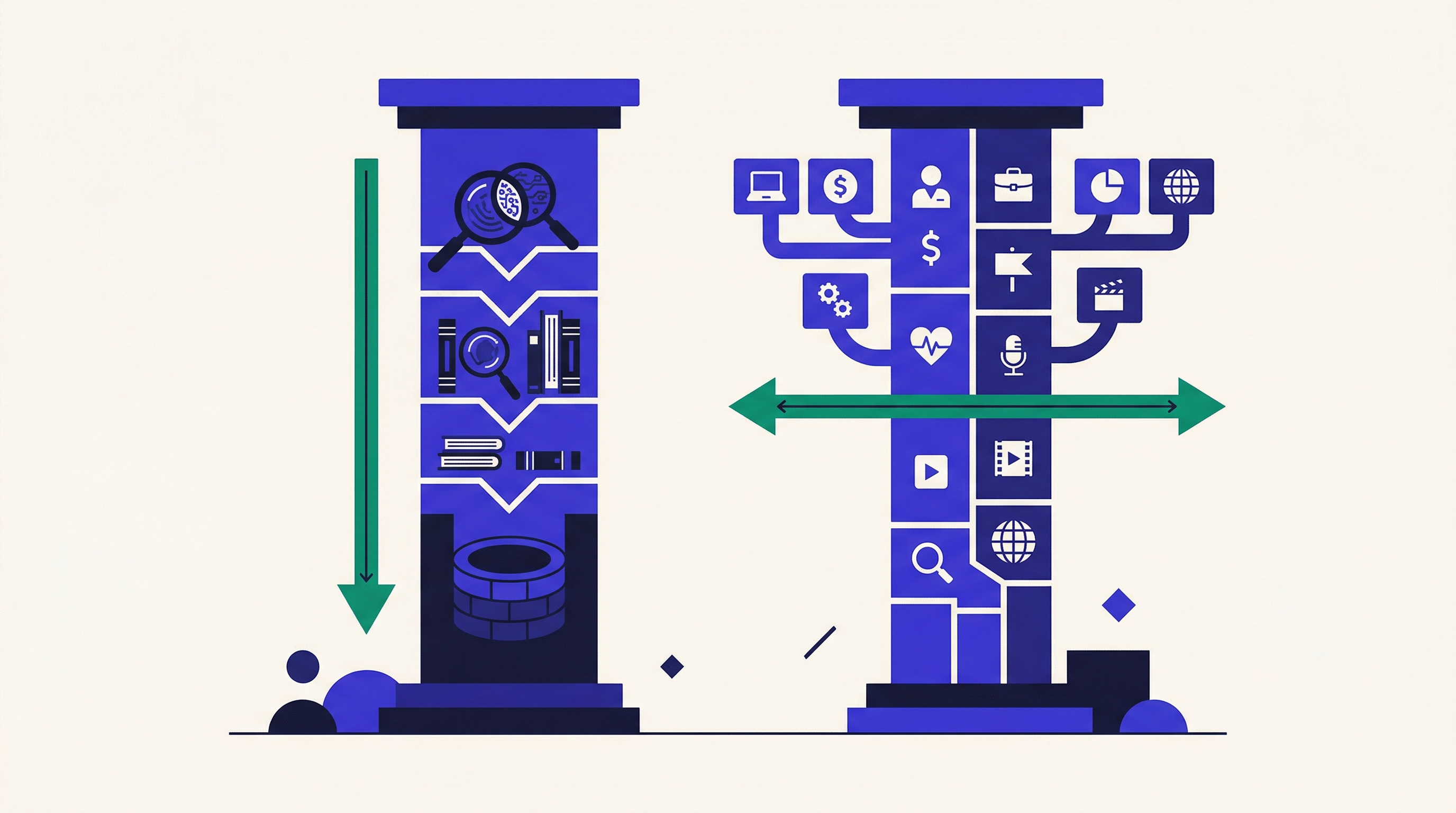
Domain authority (DA) is a third-party metric (originally by Moz, with equivalents from Ahrefs and Semrush) that estimates a website\'s overall ranking power based primarily on its backlink profile. A site with many high-quality backlinks from authoritative domains has a high DA. It is a site-wide metric — every page on the domain benefits from the overall backlink strength.
According to Joel House, founder of MentionLayer and author of AI for Revenue, "Domain authority was the north star of SEO for a decade. It still matters for Google rankings. But for AI visibility, I\'ve watched sites with DA 30 consistently outrank sites with DA 80 in AI model recommendations — because the lower-DA site had comprehensive topic coverage and the higher-DA site had one shallow article. AI models care about what you know, not who links to you."
[Topical authority](/blog/topical-authority-complete-guide) is the perceived expertise of a website on a specific subject, measured by content depth, quality, structure, and interconnection within that topic area. Unlike DA, topical authority is topic-specific — a site can have strong topical authority in "project management" and zero topical authority in "cooking."
The critical difference: DA is earned through links. Topical authority is earned through content. For AI models that make citation decisions based on source expertise rather than link equity, this distinction determines whether your content gets cited or skipped.
Head-to-Head Comparison
| Dimension | Domain Authority | Topical Authority |
|---|---|---|
| What it measures | Overall site ranking power | Topic-specific expertise depth |
| Primary signal source | Backlinks from external sites | Content quality, depth, and structure |
| Scope | Site-wide (all pages benefit) | Topic-specific (only relevant pages benefit) |
| How it is built | Link building, PR, partnerships | Content clusters, pillar pages, internal linking |
| Time to build | 6-12+ months for significant gains | 2-4 months for recognizable authority |
| Cost to build | High (link building is expensive) | Moderate (content creation + maintenance) |
| Google ranking impact | Strong across all queries | Strong for topic-relevant queries |
| AI citation impact | Moderate (indirect through rankings) | Very strong (direct through content evaluation) |
| Measurability | Third-party tools (Moz, Ahrefs, Semrush) | Proxy metrics (coverage ratio, cluster rankings, AI citation rate) |
| Decay rate | Slow (links persist for years) | Fast if content goes stale (76.4% freshness factor) |
The table reveals a key insight: domain authority is harder and more expensive to build but decays slowly. Topical authority is faster to build but requires ongoing maintenance. For AI visibility specifically, topical authority has the higher direct impact because AI models evaluate content quality and topic coverage when selecting citation sources.
This does not mean DA is irrelevant to AI. High-DA pages rank higher on Google, and AI models frequently cite sources that Google ranks well. DA creates an indirect pathway to AI visibility through Google rankings. But the direct pathway — comprehensive, well-structured content with expert attribution — runs through topical authority.
Which Matters More for AI Visibility?
The data points consistently toward topical authority as the more important signal for AI citation selection.
Evidence 1: Brand mentions correlate 3x more than backlinks with AI visibility. Brand mentions are earned through content quality and community engagement — topical authority activities — not through link building.
Evidence 2: Content with H2/H3 hierarchy and structured sections gets cited 65% more. This is a pure topical authority signal — it has nothing to do with how many sites link to you.
Evidence 3: 76.4% of ChatGPT\'s cited pages were updated within 30 days. Freshness is a topical authority maintenance activity, not a DA activity. Backlinks do not expire after 30 days, but content freshness does.
"In our experience running AI visibility campaigns at MentionLayer, we\'ve found that topical authority explains about 60% of the variance in AI citation rates across our client portfolio. Domain authority explains about 20%. The remaining 20% comes from off-site signals like Reddit mentions, reviews, and entity consistency," says Joel House.
Evidence 4: Small, focused sites can outperform large sites. A 30-page site with DA 25 that covers "AI visibility" comprehensively can earn more AI citations on that topic than a 10,000-page site with DA 85 that has one article about AI visibility. AI models evaluate per-topic expertise, not site-wide authority.
The exception: for extremely competitive head terms ("best CRM software"), high DA combined with topical authority tends to win. But for the long-tail queries that make up the majority of AI model responses, topical authority alone is often sufficient to earn citations.
Strategic Recommendations: How to Invest
The optimal strategy invests in both, but sequences topical authority first because it is faster to build and has more direct AI visibility impact.
If you have low DA + low topical authority (most startups): Start with topical authority. Build one complete content cluster with a pillar page and 8-12 supporting articles. This establishes your expertise signal for AI models within 60-90 days. Add link building as a secondary activity once your content foundation exists — earning links to comprehensive content is easier than earning links to thin content.
If you have high DA + low topical authority (established brands): Your DA advantage will help new content rank faster on Google. Invest heavily in topical authority — build content clusters that leverage your existing domain strength. You already have the ranking power; you need the content depth that converts rankings into AI citations.
If you have low DA + high topical authority (niche experts): Your content is strong but your site lacks the ranking power to get it in front of Google users (and by extension, AI models that cite Google-ranked sources). Supplement with digital PR and citation seeding to build off-site signals. These activities build both DA (through earned links) and AI visibility (through third-party mentions) simultaneously.
If you have high DA + high topical authority (market leaders): You are in the strongest position. Focus on maintenance — content refreshing to sustain freshness signals, expanding clusters to cover emerging sub-topics, and building the consensus layer through continued community engagement and earned media.
Regardless of your starting position, the 6-pillar audit measures both topical authority (through the citations, entities, and on-page pillars) and off-site authority (through the press and review pillars) to give you a clear picture of where to invest. MentionLayer then provides the tools to execute across both dimensions.
Not sure whether your topical-authority work is translating into AI citations yet? Run a free AI visibility audit — it scores your content depth and your off-site signals together and lands in your inbox in about 20 minutes, so you know which lever to pull first.
Frequently Asked Questions
Can I have topical authority without domain authority?
Yes. A new blog with DA 15 that publishes 12 comprehensive, interlinked articles about a specific topic demonstrates topical authority in that niche. AI models will cite these articles if they provide genuine expertise, original insights, and structured content — regardless of the site\'s backlink profile. The content quality and topic depth matter more than the domain\'s link equity for AI citation decisions.
Does domain authority help with AI citations at all?
Indirectly, yes. High-DA pages rank higher on Google, and AI models frequently retrieve Google-ranking pages as sources. So DA helps your content get discovered by AI models through better Google rankings. But the citation decision — whether the AI actually includes your content in its answer — depends more on content quality, topical depth, and structural signals than on DA.
How long does it take to build topical authority?
A focused content cluster with one pillar page and 8-12 supporting articles can establish recognizable topical authority within 60-90 days. Google typically registers the topical authority signal within 2-4 months. AI models can begin citing cluster content within 30-60 days if the content includes statistics, expert attribution, and structured sections. Domain authority takes significantly longer — typically 6-12+ months for meaningful gains.
Should agencies focus on DA or topical authority for client results?
For AI visibility results specifically, prioritize topical authority. It delivers faster, more measurable results — clients can see their AI visibility score improve within the first month of a focused content sprint. Supplement with link building and digital PR as secondary activities. The audit-to-action workflow in the agency guide covers how to sequence these investments for maximum client impact and retention.
Check Your AI Visibility Score
Run a free 5-pillar audit and see where your brand stands across Citations, AI Presence, Entities, Reviews, and Press.
Run Free Audit →Related Articles

Topical Authority: The Complete Guide to Dominating Your Niche in 2026

What Is Topical Authority and Why AI Models Care About It

AI SEO vs Traditional SEO: What Changed and What Didn’t in 2026

What Is Entity Authority? Why AI Models Trust Some Brands More
