Internal Linking Strategy for AI: Helping Both Google and AI Models Understand Your Site
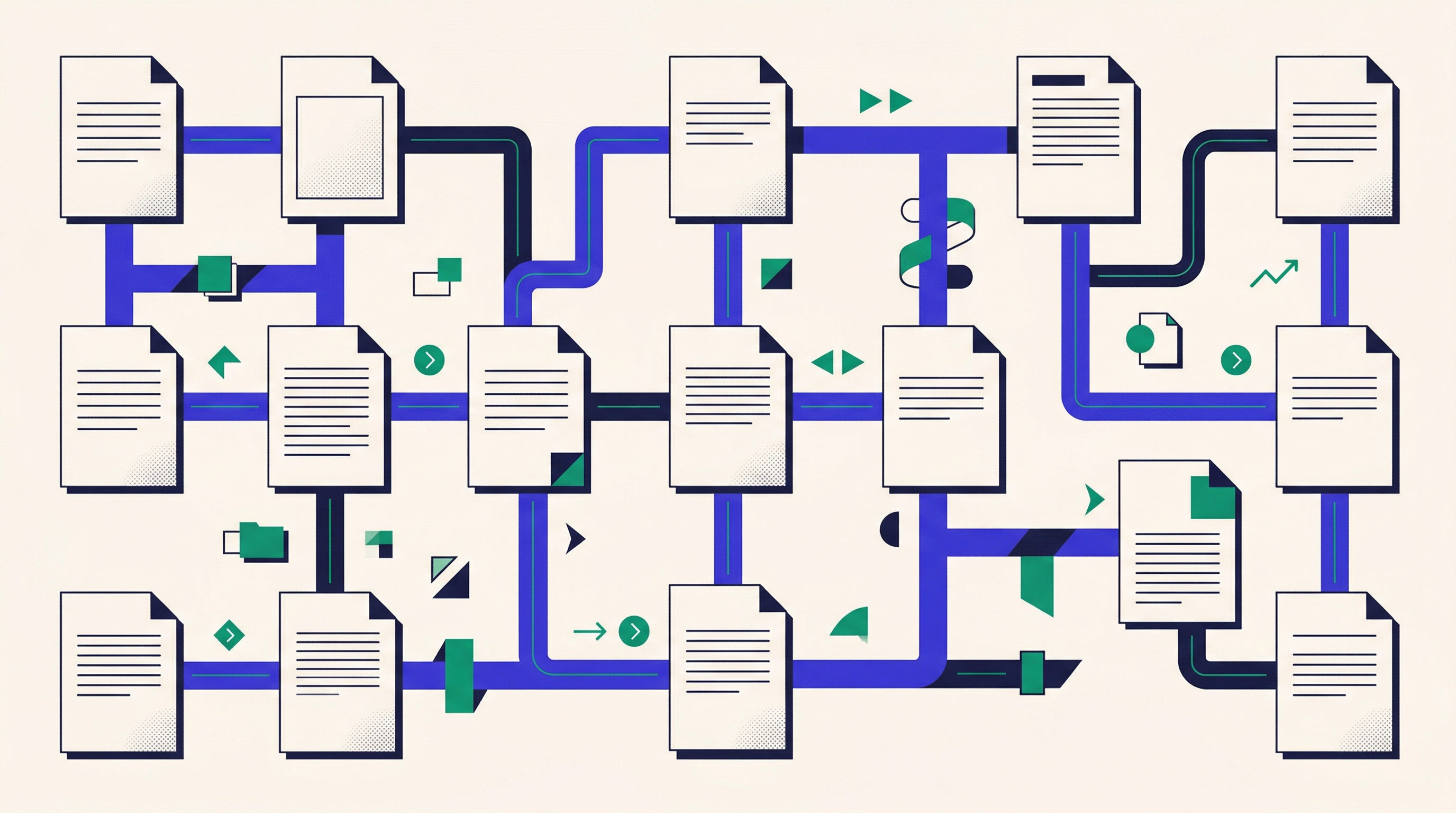
Internal linking is the connective tissue that transforms scattered content into recognized topical authority. This guide covers the 5-layer linking framework, anchor text strategy, orphan page detection, and the specific linking patterns that increase AI citation probability.

Internal linking serves dual purpose: it signals topical authority to Google through link equity flow, and it creates the cross-document validation that AI models use to decide which sources to cite. Sites with structured 5-layer linking see 65% more AI citations than those with ad-hoc linking.
Why Internal Linking Matters More Than Ever for AI
Internal linking has always mattered for SEO. But in the AI era, it matters for an additional reason: it creates the structural signals that AI models use to evaluate topical authority.
According to Joel House, founder of MentionLayer and author of AI for Revenue, "When we audit sites that consistently earn AI citations versus sites that get skipped, the single biggest differentiator after content quality is internal linking structure. The cited sites have clear cluster architectures with strong bidirectional linking. The skipped sites have content that is structurally orphaned — it exists but nothing connects it."
AI models using retrieval-augmented generation retrieve multiple documents when answering a query. When the model retrieves a document from your site and finds it links to other relevant documents on the same domain — and those documents link back — the model recognizes a structured knowledge base rather than isolated articles. This is the on-site equivalent of the consensus layer: multiple documents on the same domain validating each other\'s expertise.
Content with proper heading hierarchy and structured linking gets cited 65% more frequently. The linking structure is part of that signal — it tells AI models that your content is organized, comprehensive, and intentionally interconnected.
The 5-Layer Internal Linking Framework
Effective internal linking operates on five distinct layers, each serving a different purpose for Google and AI models.
Layer 1: Hub-and-Spoke (Cluster Links) Every supporting article links to its pillar page. Every pillar page links to each supporting article. This creates the primary topical authority signal. Use the pillar\'s target keyword as anchor text (e.g., link "topical authority" to the topical authority pillar page).
Layer 2: Sibling Links Supporting articles link to 2-3 related articles within the same cluster. These create depth signals — a reader exploring "content clusters" should naturally find links to "pillar pages" and "internal linking" within the text.
Layer 3: Cross-Cluster Links Link between clusters where topics naturally connect. Your topical authority cluster links to your citation seeding cluster when discussing content distribution. This creates site-wide topical breadth.
Layer 4: Product Page Links Where content discusses functionality your product provides, link to /features, /how-it-works, or specific help pages. These serve conversion and signal that educational content is backed by a practical solution.
Layer 5: Glossary Links First occurrence of key terms links to their definition page. This creates a natural, comprehensive link network while providing utility to readers. Common glossary terms include GEO, Share of Model, citation velocity, and entity authority.
Every article should have a minimum of 4 internal links spread across at least 3 layers. The average well-linked article has 5-8 internal links distributed naturally throughout the content.
Anchor Text Strategy for AI
Anchor text — the clickable text of a link — serves as a labeling signal for both Google and AI models. The right anchor text tells the model what the linked page is about before it even retrieves it.
Rules for effective anchor text:
- Use descriptive, keyword-rich anchors. Link "content seeding playbook" not "click here" or "this article." The anchor text should describe the destination page\'s topic.
2. Vary anchor text naturally. If 10 articles all link to the pillar page using identical anchor text, it looks artificial. Use variations: "topical authority guide," "comprehensive topical authority resource," "our topical authority framework," "building topical authority."
3. Match the linked page\'s target keyword. The most powerful internal link uses the destination page\'s target keyword as (or within) the anchor text. This directly reinforces the page\'s topical signal.
4. Avoid generic anchors. "Learn more," "read this," "click here," and "this post" waste linking opportunities. Every link is a chance to reinforce topical signals.
5. Keep anchors concise. 2-6 words is the sweet spot. Overly long anchor text dilutes the signal.
"Anchor text is one of the strongest on-page signals you control. When your internal links use descriptive anchors that match the target page\'s topic, you are literally telling Google and AI models what your content is about. Wasting that signal on \'\'click here\'\' is leaving authority on the table," says Joel House.
For AI models specifically, descriptive anchor text helps with context propagation. When Perplexity retrieves a page and scans its internal links, the anchor text provides a map of related topics on your domain — increasing the probability that the model retrieves additional pages from your site for cross-validation.
Finding and Fixing Orphan Pages
An orphan page is a published page that has zero or very few internal links pointing to it. For AI visibility, orphan pages are dead weight — they exist in your content library but the cluster structure does not support them, so AI models are unlikely to discover or trust them.
How to identify orphan pages: 1. Run a site crawl (Screaming Frog, Sitebulb, or Ahrefs Site Audit) 2. Sort pages by "inbound internal links" ascending 3. Any page with fewer than 3 internal links pointing to it is functionally orphaned 4. Compare against your content map — every cluster article should appear in the crawl with 3+ inlinks
How to fix orphan pages: - Identify which cluster the orphan page belongs to - Add a link to it from the cluster\'s pillar page (in a relevant context within the body) - Add links from 2-3 sibling articles that discuss related sub-topics - Update the orphan page to link to the pillar and 2-3 siblings
Prevention: maintain a content map spreadsheet that tracks every article\'s inbound and outbound internal links. Update it after every publish. Review it monthly. Flag any article that drops below 3 inbound links.
The internal link audit should be part of your monthly content maintenance routine. The content refresh playbook includes internal linking as one of the key refresh activities — every time you update an article, check its link profile and strengthen any weak connections.
For larger sites, the MentionLayer audit includes entity and structure analysis that identifies linking gaps across your content. The audit surfaces orphan pages, weak cluster connections, and missing glossary links as part of the entity pillar assessment.
Implementation Checklist
Use this checklist when publishing any new article or auditing existing content.
Per-article linking checklist: - [ ] Links to the cluster\'s pillar page (Layer 1) - [ ] Links to 2-3 sibling articles in the same cluster (Layer 2) - [ ] Links to at least 1 article in a different cluster (Layer 3) - [ ] Links to at least 1 product page where natural (Layer 4) - [ ] First occurrence of glossary terms linked to definitions (Layer 5) - [ ] Minimum 4 internal links total, spread across sections - [ ] Anchor text is descriptive and keyword-relevant - [ ] No "click here" or generic anchors
Monthly site-wide audit: - [ ] Run crawl and check for pages with < 3 inbound internal links - [ ] Verify all pillar pages link to all their supporting articles - [ ] Check that newly published articles have been linked from existing content - [ ] Review anchor text distribution — avoid over-repetition - [ ] Verify cross-cluster links exist between all major topic areas
| Linking Layer | Purpose | Target Per Article |
|---|---|---|
| Hub-and-spoke | Cluster authority signal | 1 pillar link |
| Sibling | Depth signal | 2-3 sibling links |
| Cross-cluster | Breadth signal | 1+ cross-cluster link |
| Product pages | Conversion + authority | 1+ product link |
| Glossary | Comprehensiveness | All key terms (first occurrence) |
The time investment for proper internal linking is approximately 10-15 minutes per article during writing, plus 1-2 hours per month for the site-wide audit. This is among the highest-ROI activities for AI visibility — it costs nothing except attention and directly influences how AI models evaluate your topical authority.
Not sure whether your link structure is helping or hurting? A free AI visibility audit surfaces orphan pages and weak cluster connections alongside the rest of your AI presence — results emailed in about 20 minutes.
Frequently Asked Questions
How many internal links should each article have?
Minimum 4 internal links spread across multiple sections. The optimal range is 5-8 links per article, distributed across the 5 linking layers: pillar link, sibling links, cross-cluster link, product page link, and glossary term links. More is fine if natural, but avoid forcing links where they do not serve the reader.
Does internal linking help with AI visibility specifically?
Yes. AI models using retrieval-augmented generation retrieve multiple documents for each query. When they find well-linked documents from the same domain, they gain confidence in the source\'s topical authority. Sites with structured internal linking get cited 65% more frequently. The linking structure tells AI models your content is organized, comprehensive, and intentionally interconnected.
Should I use exact-match anchor text for internal links?
Use the target page\'s primary keyword naturally within the anchor text, but vary the phrasing across different linking articles. If 10 articles all link to a page using the identical anchor text, it looks artificial. Variations like "topical authority guide," "building topical authority," and "comprehensive topical authority resource" all reinforce the same signal while appearing natural.
How do I find orphan pages on my site?
Run a site crawl using Screaming Frog, Sitebulb, or Ahrefs Site Audit. Sort pages by inbound internal links in ascending order. Any page with fewer than 3 internal links pointing to it is functionally orphaned and unlikely to earn AI citations. Fix orphan pages by adding links from the relevant pillar page and 2-3 sibling articles.
Check Your AI Visibility Score
Run a free 5-pillar audit and see where your brand stands across Citations, AI Presence, Entities, Reviews, and Press.
Run Free Audit →Related Articles

Topical Authority: The Complete Guide to Dominating Your Niche in 2026

Pillar Pages and Topic Clusters: Building Authority That AI Recognizes

How to Build Topical Authority That AI Models Trust

What Is a Content Cluster? The Building Block of AI Authority
